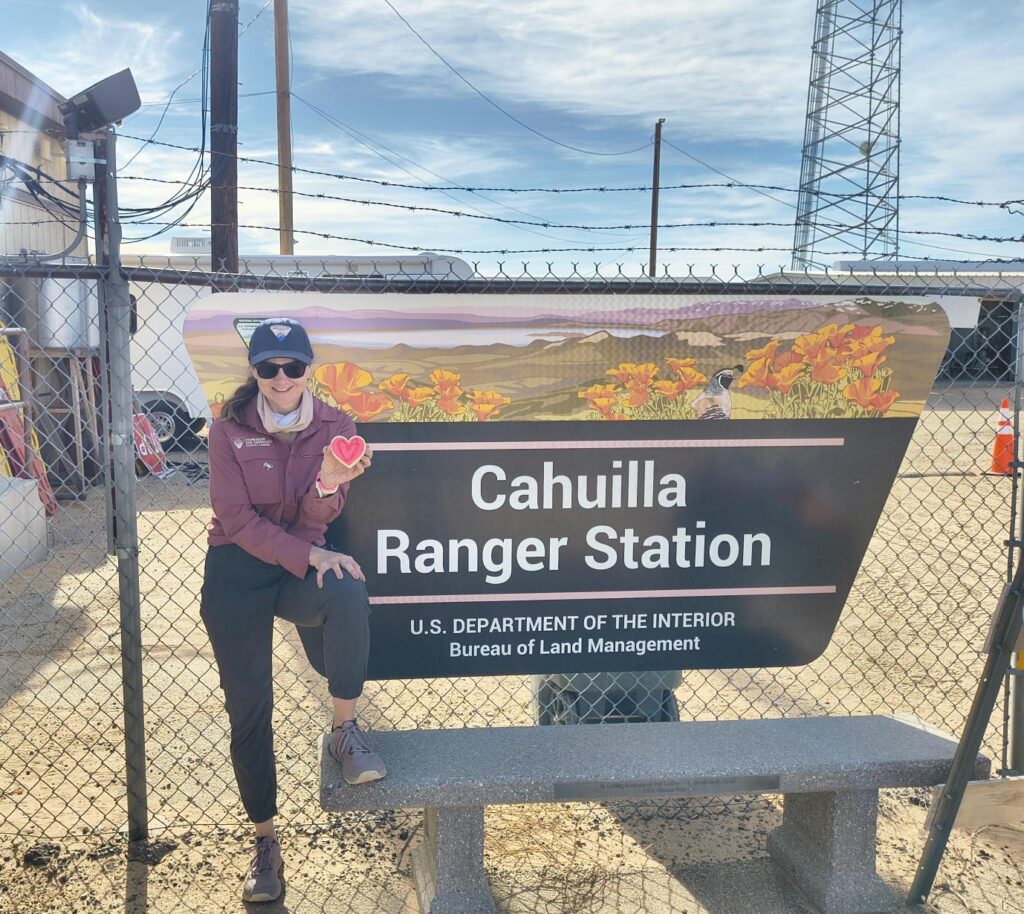
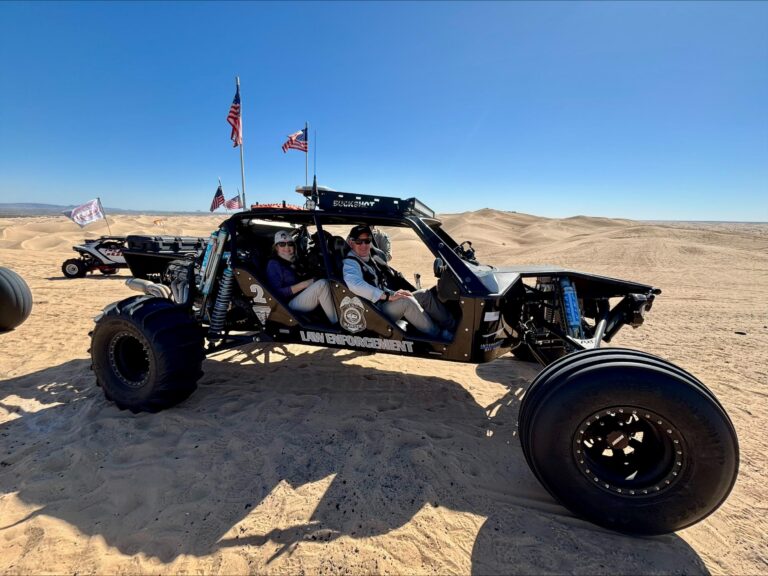
I often say that if you care about public lands, you need to get out of the office and onto the land. Earlier this year, I had the opportunity to do just that. The Bureau of Land Management’s (BLM) El Centro Field Office invited me to lace up my trail runners and explore the other worldly, sun-kissed sands of the Imperial Sand Dunes, one of the world’s most popular off-highway vehicle destinations. The dunes stretch more than 40 miles long and nearly five miles wide, rising hundreds of feet above the desert floor. The landscape is striking, but what truly makes this place special is the people.
I saw thousands of OHV enthusiasts who had traveled from across the country come together to ride the dunes. Families, friends, and entire communities gathered to spend time outdoors and connect.
Taking care of the Imperial Sand Dunes is a big job, and no single group can do it alone. The BLM works closely with local community groups including the American Sand Association who helps provide vital feedback to help steward the land, support safe recreation, and respond when emergencies happen. Visitors may not see the level of coordination behind the scenes, but it is essential. During my ride along, I saw firsthand when the BLM first responders arranged a life flight for two young riders who were injured. It was a clear reminder that stewardship means caring for both the land and the safety of the people who depend on it.
Being there reinforced something I believe deeply, that if you care about public lands, investing in places alone is not enough. We must invest in long-term, multiple-use stewardship in order to support all the ways the public uses them.
A Strong Start to 2026
That is exactly what we are focused on at the Foundation for America’s Public Lands, setting the biggest table possible and helping local stewardship leaders turn their great ideas into real on-the-ground impact. We began the year by identifying where we could make the greatest difference for the BLM and the communities it serves. We announced our newest round of projects for 2026 and shared the latest Lands to Love® Catalyst Fund grants. With these investments, the Foundation has directed $11.5 million into 55 projects across BLM lands and waters. These efforts are improving recreation access, strengthening rangeland health, and fostering a culture of shared stewardship and volunteerism.
Here are a few examples of Foundation-funded projects that solve real-world problems and deliver tangible benefits to local communities and public lands:
Reducing Flooding Impacts to the City of Moab
Moab, Utah, arguably the country’s best-known gateway community, welcomes millions of visitors each year to nearby BLM trails and national parks. In recent years, however, the community has faced a different kind of pressure. Destructive flooding that has damaged homes, businesses, and livelihoods.
Flash floods aren’t new here, but they’ve become more intense. The cause can be traced in part to the Pack Creek Fire of 2021, which burned large portions of the surrounding watershed, leaving soils exposed and unstable. In the years since, Mill Creek, which runs through downtown, has carried increasing volumes of debris and sediment off the scarred slopes, bringing mud and damage into the center of town.
The Foundation, along with many other stewardship organizations organized and supported by Utah’s Watershed Restoration Initiative, is investing in efforts to stabilize and restore Mill Creek, reduce flooding, better protect the community, and improve the health of the watershed.
Combatting Drought Impacts Through Precision Grazing
The Foundation is helping ranchers manage grazing on drought-prone rangelands by providing tools like virtual fencing. This lets ranchers guide and monitor livestock in real time, adjust grazing as conditions change, and better manage water and sensitive areas.
One such place we are making investments is The Massey Ranch, located in western New Mexico. The ranch has been in the same family for seven generations. Over the years, they’ve worked the land, raised families, and always tried to leave the land better than they found it.
But the rangelands of western New Mexico are drought-prone. Limited water and stressed vegetation make it more difficult to manage grazing in ways that support both the operation and the health of the land.
With this flexibility, families like the Masseys are better prepared to handle drought and keep caring for the land for future generations.
Breaking Through Gridlock to Expand Recreation Access
Capitol Reef National Park has seen its number of visitors grow by more than 80 percent over the last ten years. Campgrounds inside the park are full, and more people keep coming to experience one of Utah’s “Mighty 5” natural wonders.
Luckily, the BLM manages much of the land surrounding Capitol Reef, and there’s been significant interest in creating a new campground to meet demand. To the point that most of the planning was done to start breaking down. But there was a problem: the project was caught in bureaucratic limbo because a required transportation impact study hadn’t been funded.
The Foundation stepped in to fund that study, helping move the project forward. With that final step complete, the project can now proceed, creating more opportunities for people to spend time in this landscape.
These are the kinds of practical challenges we are focused on solving. Behind each solution are local leaders working to strengthen their communities and care for the land. Our role is to support them by bringing partners together, unlocking funding, and helping turn good ideas into real impact.
Advocating for Public Lands in Congress
I also recently had the opportunity to testify before Congress, where I shared a simple but important message: America’s public lands and waters are a key part of who we are, and it takes all of us to care for them.
We’re focused on setting the biggest table possible and tackling long-standing challenges facing public lands with practical solutions. That includes reducing bureaucratic barriers that slow progress, piloting new technologies that support ranchers and improve land management, and helping implement key legislation such as the EXPLORE Act to expand recreation access for all Americans.
Our Shared Future
At the core of our work is a simple goal: make every federal dollar go further and deliver greater results on the ground.
And we’re already seeing momentum build. Interest from corporate partners and the philanthropic community continues to grow, signaling a shared commitment to the future of our public lands!
I look forward to continuing this work alongside all of you to turn shared priorities into meaningful action and ensure America’s public lands remain healthy, accessible, and productive for generations to come.

I Ling Thompson
Chief Executive Officer and President
The Foundation for America’s Public Lands