One year after its first project together at Cotoni-Coast Dairies to support grazing and public recreation access, the partnership expands virtual fencing projects on public lands.
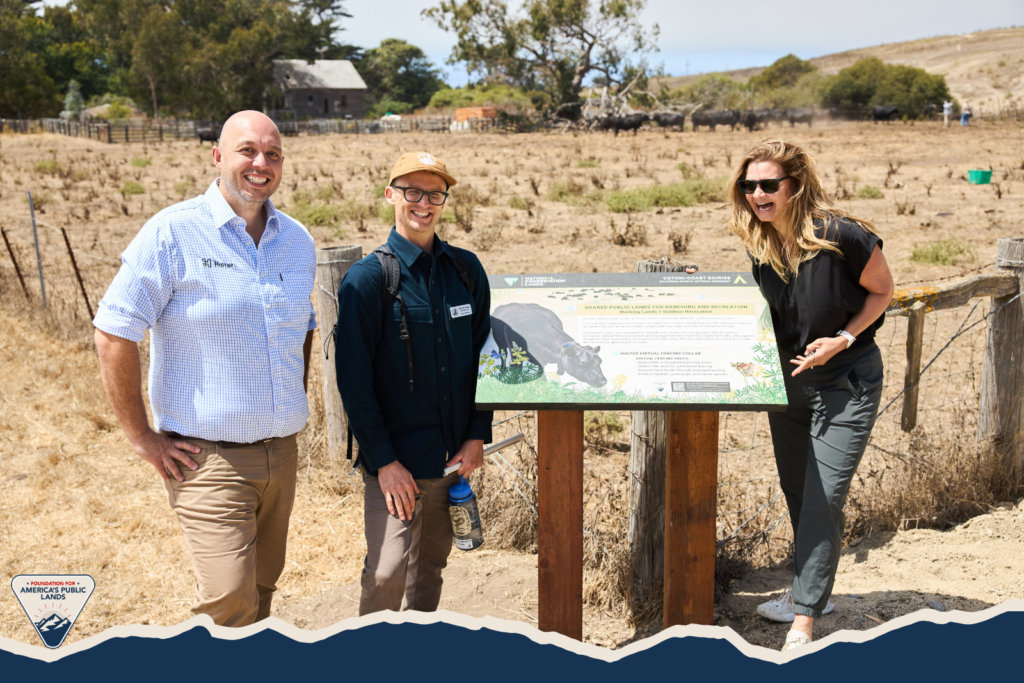
WASHINGTON, D.C., AUG, 24 2026 – The Foundation for America’s Public Lands, the official charitable partner of the Bureau of Land Management (BLM), and Halter, a leading operating system for pasture-based ranching, are expanding their virtual fencing partnership to support more ranchers and communities. The partnership launched one year ago at Cotoni-Coast Dairies near Santa Cruz, California, demonstrating how the technology can help balance the multiple uses of BLM-managed public lands. There, the Foundation and Halter worked together to deploy virtual fencing to keep livestock off newly constructed trails and support rotational grazing. Since the site opened, the BLM has reported that nearly 100,000 visitors have enjoyed the area, while the existing ranching operation continues.
The partnership has since expanded virtual fencing on BLM-managed public lands across western states, including new projects at the Rio Grande del Norte National Monument in New Mexico and the Muddy Creek watershed in Wyoming.
A partnership for public lands
The BLM manages 245 million acres of public land nationwide, all of it stewarded for multiple uses. More than 60 percent (155 million acres) is available for grazing, supporting 18,000 grazing permits and leases.
Through its partnership with Halter, the Foundation for America’s Public Lands has committed nearly $3 million to bring virtual fencing to ranchers on BLM-managed public land, funding 15 projects to date, including those where ranchers have selected Halter to help manage their grazing. On those projects, ranchers have put Halter collars on more than 4,500 cattle and drawn over 1,300 miles of virtual fence, managing grazing in even the most difficult terrain thanks to the collars’ direct-to-satellite connectivity.
“Healthy rangelands keep our public lands productive, and we’re proud to expand our work with Halter, partnering with ranchers to give them more options to improve rangeland health across more public lands,” said I Ling Thompson, CEO of the Foundation for America’s Public Lands. “As the official charitable partner of the Bureau of Land Management, we’re focused on bringing practical, innovative solutions to the 155 million acres of BLM-managed lands that support livestock grazing. Virtual fencing puts real tools in ranchers’ hands that support modern ranching and help these hardworking lands thrive for generations to come.”
“What we’re building with the Foundation for America’s Public Lands gives ranchers real flexibility to improve grazing while sharing that same ground with recreation, wildlife, and habitat restoration. A year after Cotoni, seeing virtual fencing thrive on public land like at Rio Grande del Norte and Muddy Creek tells us this isn’t just a one-off idea; it’s a model that holds up in the long term. We’re proud of what this partnership has built, and are excited to see where it goes next,” said Andrew Fraser, President of Halter.
Ranchers at work across the West
In New Mexico, the Foundation and Halter are supporting ranchers in the Rio Grande del Norte National Monument, where livestock have been part of the landscape for generations. The use of traditional fences here is often cost-prohibitive and can conflict with the area’s wild and rugged characteristics, wildlife migration corridors, and cultural history. Working alongside the Friends of the Rio Grande del Norte National Monument, ranchers are using virtual fencing to support adaptive grazing across an ecologically and culturally sensitive landscape.
Farther south in New Mexico’s Hidalgo County, a seventh-generation ranching family is using virtual fencing across their 30,000-acre operation to improve the ranch’s efficiency, adapt to persistent drought, and strengthen rangeland health.
In Wyoming’s Muddy Creek watershed, the partnership is supporting efforts by BLM and Trout Unlimited to restore degraded waterways in an important tributary of the Colorado River Basin. After years of restoration efforts, the partnership equips ranchers with virtual fencing technology to manage livestock with greater precision and flexibility in newly restored areas, leading to a healthier, more resilient watershed.
“Virtual fencing has become the newest and most useful tool on our operation, allowing us to adapt grazing in real time across our 30,000 acres,” said Cash and Kanzas Massey, ranchers of Three Mile Hill LLC in Animas, New Mexico. “It’s improved efficiency, helped us respond to drought, and strengthened the health of the rangeland for the long term. We appreciate the Foundation’s support and the quality and customer service of the Halter team.”
Looking ahead
Halter and the Foundation plan to expand the partnership to additional projects on BLM-managed public lands over the coming year, continuing to demonstrate how the BLM, ranchers, local communities, and technology providers can work together to keep public lands productive, healthy, and accessible for generations to come.
ABOUT THE FOUNDATION FOR AMERICA’S PUBLIC LANDS
As the official charitable partner of the Bureau of Land Management (BLM), the Foundation for America’s Public Lands serves as a convener, partner, and fundraising catalyst to help ensure the health and stewardship of America’s public lands and waters today, and for the future. To learn more, visit americaslands.org.
The Foundation funds projects that solve real-world problems for local communities and public lands. To date, the Foundation has leveraged more than $20 million in 88 on-the-ground projects across the country. Support for these investments is made possible by federal and state funding, as well as the generous backing of charitable partners and donors.
ABOUT HALTER
Halter serves more than 3,500 farmers and ranchers across the United States, New Zealand, and Australia, and has 1.5 million of its solar-powered GPS-enabled collars on cattle around the world. The company is headquartered in Auckland, New Zealand, with a U.S. office in Colorado, and Australian operations in Melbourne. To learn more, visit halterhq.com.